
There is a moment in the evening when familiar places begin to look different. A window becomes a frame for blue light. A garden path loses its sharp edges. Across the water, a single illuminated room draws more attention than an entire building did in daylight.
Peaceful evening paintings hold our attention through these small changes. As detail recedes, a gesture, reflection or empty chair can become the centre of a picture. For anyone choosing calming wall art, this gives twilight scenes a particular appeal: they invite us to spend time looking.
Three works in the Peaceful Artworks print collection explore this transition: John Singer Sargent's The Luxembourg Gardens, Frank Bramley's When the Blue Evening Slowly Falls, and Henri Le Sidaner's Small Table in Evening Dusk. Together, they take us from a public garden to a private room and finally to a table beside still water. Each offers a different way of spending the quiet hour.
John Singer Sargent's Luxembourg Gardens: A Peaceful Evening Walk

In Sargent's garden, the day has softened without quite ending. A couple occupies the foreground, while other visitors gather around the paths and water beyond. Above them, a warm disc of moonlight hangs in a much cooler sky.
The broad, pale foreground gives the figures room. Our eyes can travel towards them without having to negotiate a crowd of competing details. Behind, darker trees enclose the garden, while statues and stonework punctuate its boundaries.
Small touches of colour keep the scene alive. Red flowers interrupt the subdued greens; the woman's pink dress gives the central pair a delicate distinction. Evening here remains sociable. People are still walking, sitting and enjoying the last light.
Try looking first at the couple, then at the distant visitors. The movement between those two scales gives the painting much of its appeal: one recognisable encounter within a larger shared space.
View The Luxembourg Gardens by John Singer Sargent.
Frank Bramley's Blue Evening: Stillness Beside an Open Window
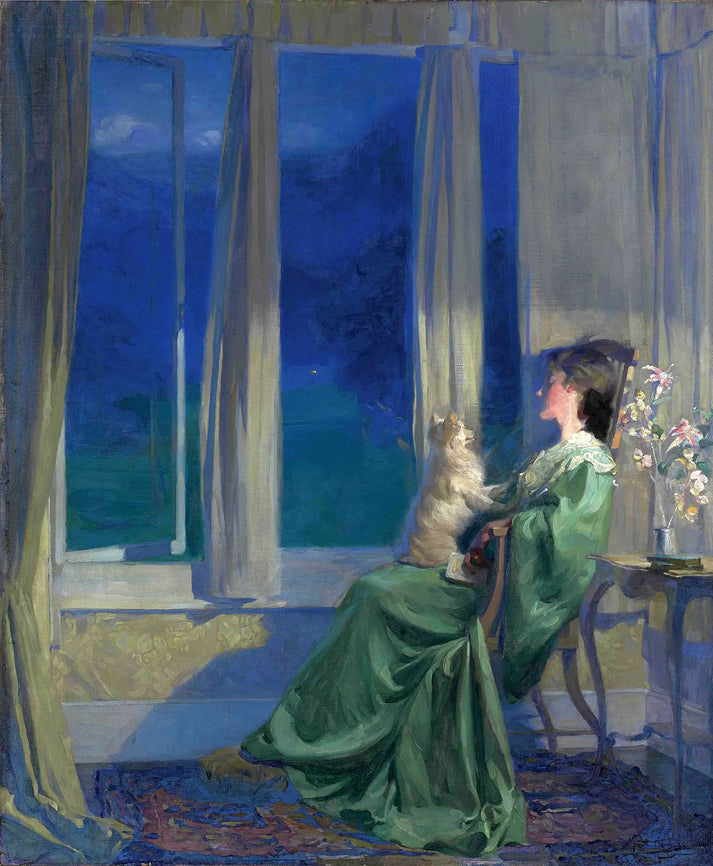
Bramley brings us indoors, but the evening outside dominates the room. Tall windows open onto a deep blue landscape. Beside them sits a woman in a green dress, accompanied by a pale cat whose upright posture echoes her attention towards the view.
Notice how much space the windows occupy. The figure sits low and to one side, allowing the blue beyond to become an almost physical presence. Pale curtains divide that colour into long vertical passages, while the folds of the dress spread across the lower part of the composition.
The painting leaves the woman's thoughts unresolved. Her stillness gives us time to notice the small relationship between person, animal and view. The cat's alertness adds a gentle counterpoint to her repose.
Here, evening is something watched from a comfortable threshold. The room offers shelter, while the open window keeps the world close.
View When the Blue Evening Slowly Falls by Frank Bramley.
Henri Le Sidaner's Small Table in Evening Dusk: A Place to Pause
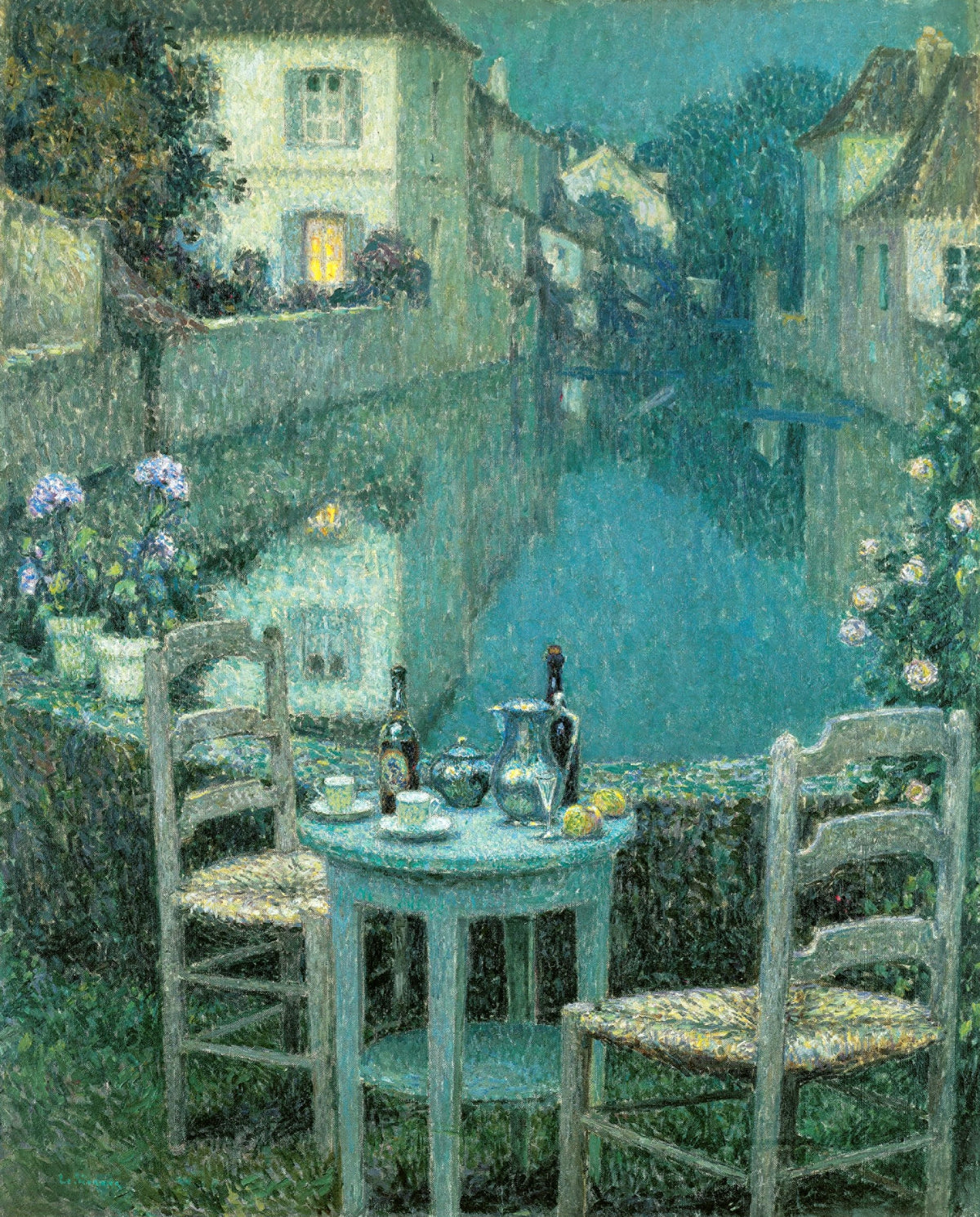
Le Sidaner removes the figures altogether. Two chairs stand around a small table holding bottles, glassware and crockery. Beyond, houses rise beside water that carries their reflections. A bright window provides a concentrated note of warmth.
The empty chairs invite us to imagine an ordinary human moment. Someone might have just stepped away; someone might be about to sit down. The painting allows both possibilities.
Look at the relationship between the table and the water. Their related blue-green tones connect the near space with the view beyond. Bottles and chair backs supply firmer shapes, while the reflections loosen the buildings into patches of colour.
That small illuminated window becomes especially noticeable because so much of the scene shares a cool palette. Follow it down into the reflection, then return to the waiting table. The composition quietly brings our attention back to a place we could occupy.
View Small Table in Evening Dusk by Henri Le Sidaner.
What Makes These Evening Paintings Feel Peaceful?
Placed together, these paintings suggest a gradual withdrawal from the activity of the day. Sargent gives us company in a public garden. Bramley offers companionship within a room. Le Sidaner leaves traces of human presence in an unoccupied setting.
Their stillness depends on different choices. Open ground gives Sargent's figures space. Bramley's windows hold our attention through a large expanse of blue. Le Sidaner's empty chairs encourage us to supply the missing people.
A useful way to compare them is to ask where you would stand within each scene. Would you join the walk through the gardens, sit beside the window, or take the empty chair by the water? That imagined position can explain an attraction to a painting more clearly than a colour preference alone.
Choosing Peaceful Art Prints for Your Living Room or Bedroom
Consider the kind of scene you would enjoy returning to. Sargent's garden offers a sense of walking out into the world. Bramley's interior suits an interest in private, reflective moments. Le Sidaner's table gives the viewer an inviting place within the composition.
The works also offer different shapes and rhythms. Sargent's horizontal garden opens across the wall, while the upright Bramley and Le Sidaner images draw attention through windows, buildings and chair backs. Consider the available wall space and check the dimensions on the individual print page before choosing a size.
For a living room, a broad garden view can sit comfortably above a sofa or console. An upright evening scene may work beside a reading chair or on a narrower bedroom wall. These are starting points: the scene you most enjoy looking at should guide the choice.
If you display the prints together, their shared evening colours provide a connection. Give each image enough space to be seen on its own. Repeating a frame finish can help the group feel considered while allowing the paintings' different moods to remain visible.
Questions About Peaceful Evening Art Prints
Which artists painted the evening scenes featured here?
This selection brings together John Singer Sargent, Frank Bramley and Henri Le Sidaner. The works are dated 1879, 1909 and 1921 respectively in the Peaceful Artworks catalogue.
Can I explore each painting as a print?
Yes. Each image and caption links to its corresponding fine art reproduction print in the Peaceful Artworks shop. The product pages provide the current size options and ordering details.
How can I choose between the three prints?
Start with the setting that draws you in: Sargent's public garden, Bramley's window-side interior or Le Sidaner's waterside table. Then compare the composition's shape with the wall where you intend to display it.
In these pictures, the end of the day becomes a subject worth lingering over. A couple continues its walk, a woman watches the darkening view, and a table waits beside the water.
Explore more peaceful art prints at Peaceful Artworks.
Artwork titles and dates follow the Peaceful Artworks catalogue. Descriptions of mood and composition are editorial interpretations. The featured products are reproduction prints of historical artworks.