
A woodland stream can look still until you begin to notice what is happening on its surface. Trees reappear as reflections, stones disturb the water, and a patch of light reveals the depth of a shaded bank. These are the small events that make Peder Mørk Mønsted’s landscapes worth returning to.
The Danish painter brought patient observation to forests, snow-covered countryside and Mediterranean scenes. In this guide, we explore five Peder Mørk Mønsted paintings available as unframed fine art prints, looking at the details that give each landscape its atmosphere. The images show the paintings themselves, so you can compare their full compositions before choosing a frame.
Who Was Peder Mørk Mønsted?
Peder Mørk Mønsted (1859–1941) was a Danish artist known especially for naturalistic landscape painting. He trained in Aarhus before entering the Copenhagen Academy in 1875. He left in 1879 without taking the final examination and continued learning from other artists, including Peder Severin Krøyer and William-Adolphe Bouguereau.
His subjects extended well beyond Denmark. Travels through Europe and the Mediterranean, as well as North Africa and the Middle East, gave him a wide range of landscapes to paint. The Dahesh Museum of Art’s account of his career places his Scandinavian scenes alongside that broader interest in place and season.
For the viewer, this variety is revealing. A snowfield and a Capri lane have little in common as subjects, yet both give Mønsted opportunities to describe how light falls across an uneven surface. The five works below can be enjoyed as individual views and as different answers to that same visual problem.
Why His Landscapes Reward A Closer Look
It is tempting to describe a detailed landscape simply as realistic and leave it there. But detail alone does not explain why a picture holds our attention. In these works, paths, banks and streams lead the eye through the space, while larger areas of shade or sky keep the scene from feeling crowded.
Start by standing back from the image. Where is its lightest area? What route would your eye take into the landscape? Then look more closely at a small passage of water, foliage or stone. The interest lies in the relationship between those two scales: the convincing whole and the marks that make it possible.
Five Mønsted Paintings To Explore
1. A Woodland Stream
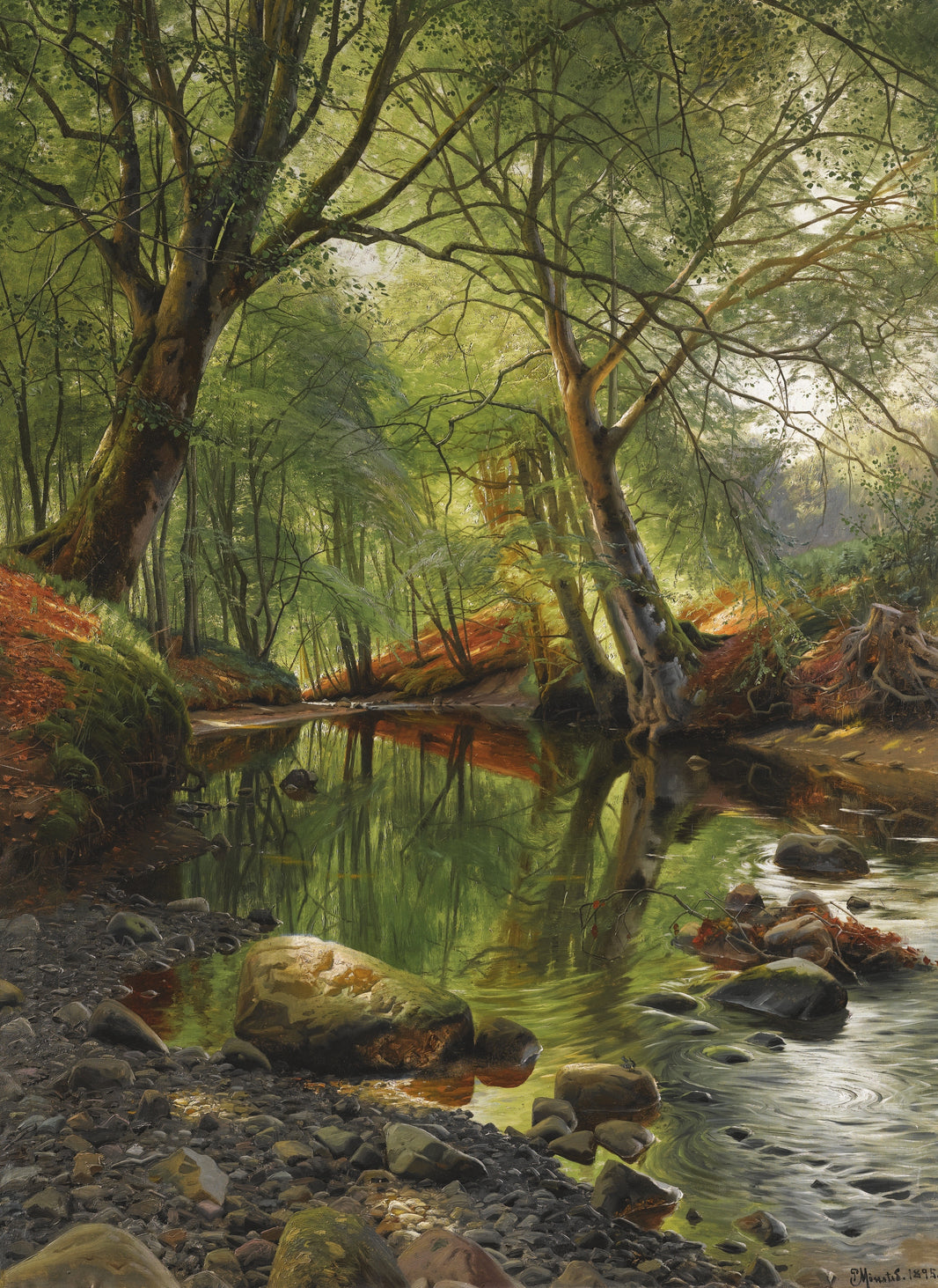
The trees seem to form a room around the water. Trunks rise at different angles, branches cross overhead, and the stream holds a second, darker version of the woodland. Near the foreground, stones interrupt the reflective surface and give the eye something solid to rest on.
There are two ways to follow this painting. You can travel into the distance along the water, or move across the surface, comparing bark, moss, leaves and reflections. Mønsted makes those different kinds of attention compatible. The small details do not prevent the larger space from feeling clear.
Look especially at the reflected trunks. They connect the upper and lower halves of the picture, but the reflection is not simply a second copy of the forest. The darker colour and broken edges make the water feel like a material in its own right.
As an unframed landscape print, this is a strong starting point for a reading corner or study. Its tall format draws the eye upward into the canopy, while the deep greens can sit comfortably beside warm wood and a simple neutral wall.
View A Woodland Stream As An Unframed Print
2. A River Landscape
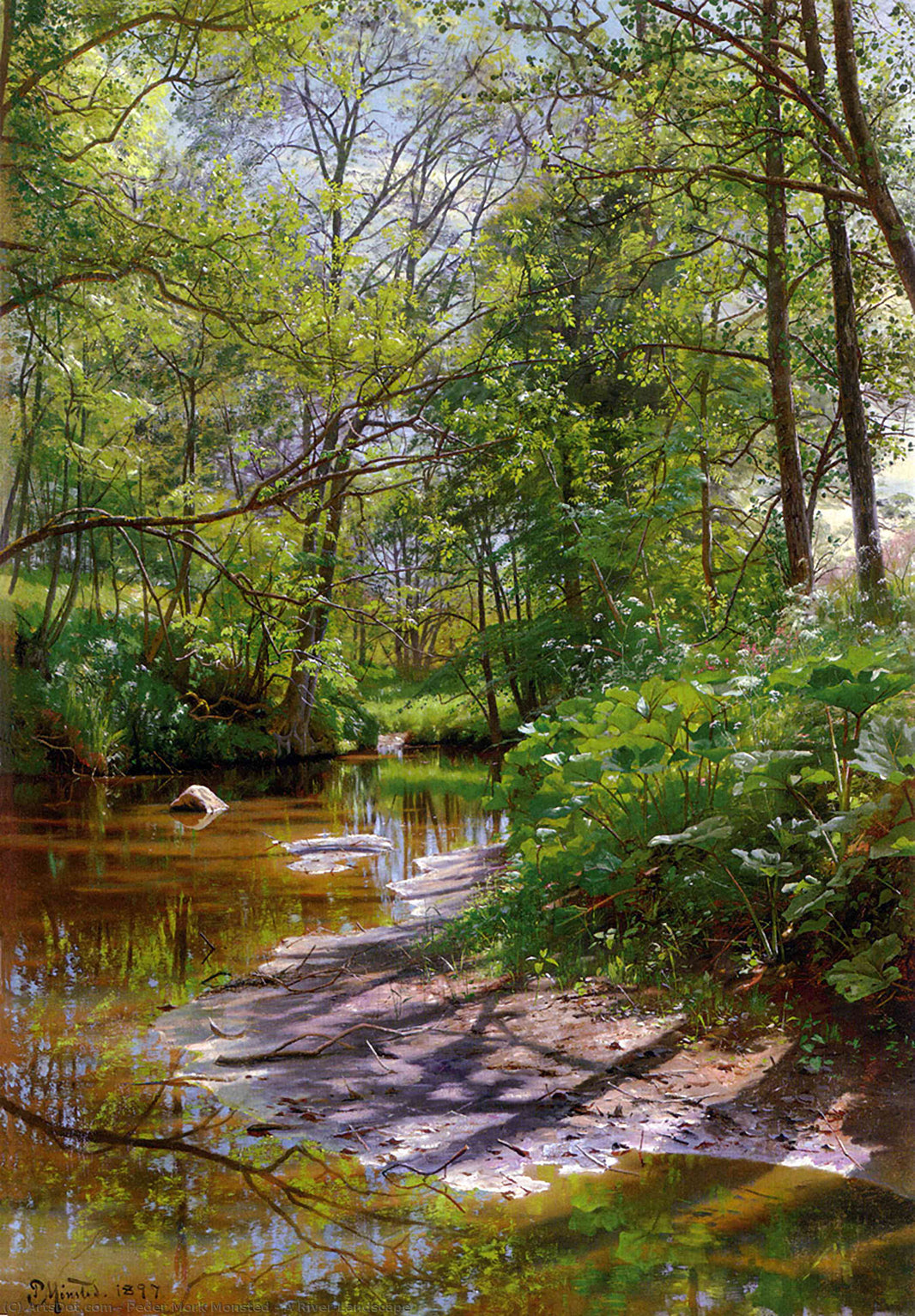
At first, this might seem a close relative of A Woodland Stream: another place where trees and water meet. Stay with it, though, and a different subject emerges. The illuminated bank and the shadows running across it turn the foreground into a record of light passing through branches.
The water offers a relatively open area beside the dense greenery. That contrast matters. Without it, the foliage might become an uninterrupted wall of detail; with it, the scene has somewhere to breathe. The pale stones and small bright leaves give the eye stepping points through the composition.
Try tracing one shadow across the ground, then looking up for the branches that might explain it. This is part of the pleasure of Mønsted’s naturalism: the scene encourages you to understand how its parts belong together.
The two woodland pictures could form a thoughtful pair, but they need not hang side by side. Repeating their greens in different rooms can create continuity while allowing each image its own space.
View A River Landscape As An Unframed Print
3. Sunny Winter Day
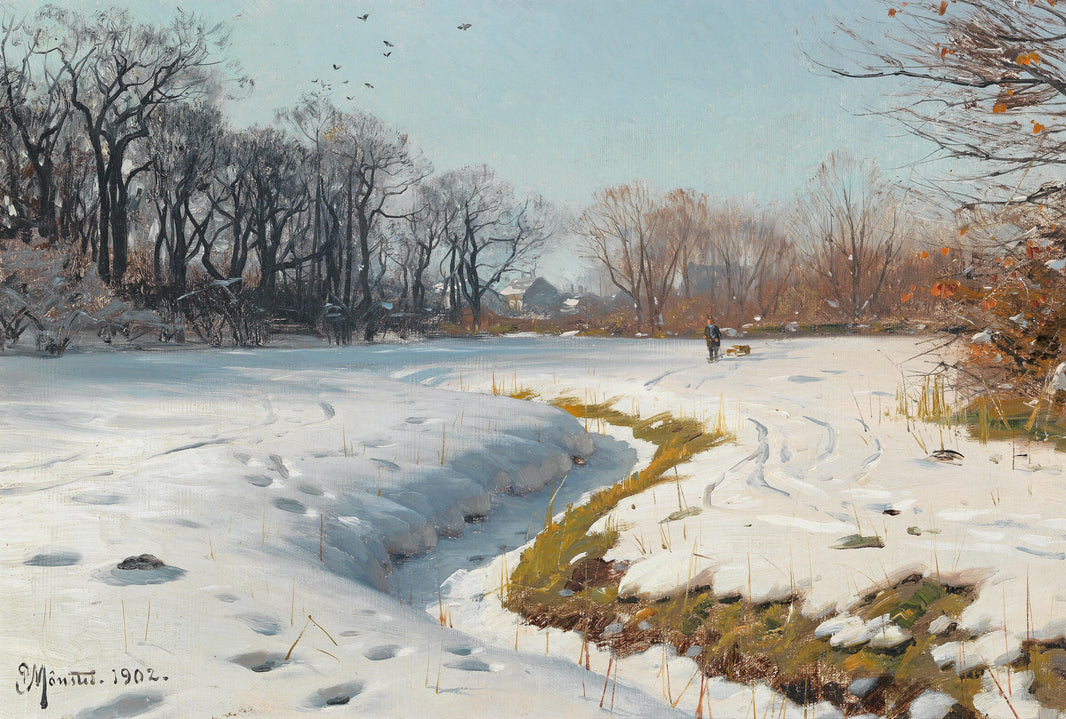
Winter clears the scene of the leafy abundance seen in the woodland paintings. Bare trees mark the horizon, snow opens up the foreground, and an exposed winding strip leads us towards the distance. The effect is spacious without being empty.
Begin with the snow rather than the trees. Its surface shifts between brighter light and cooler shadow, giving shape to ground that might otherwise look flat. The small variations are essential: the impression of a winter day comes from relationships between tones, not from white paint alone.
The darker tree line provides a firm edge against the pale sky and field. Meanwhile, the bend in the foreground prevents the composition from becoming a simple stack of horizontal bands. It gives the eye a route to follow.
For a room, this painting offers a lighter alternative to the deep woodland greens. It may suit a bedroom or quiet landing, especially where a restrained palette is welcome. A frame with some tonal contrast can help its pale edges remain distinct from a light-coloured wall.
View Sunny Winter Day As An Unframed Print
4. Sunlight In Anacapri
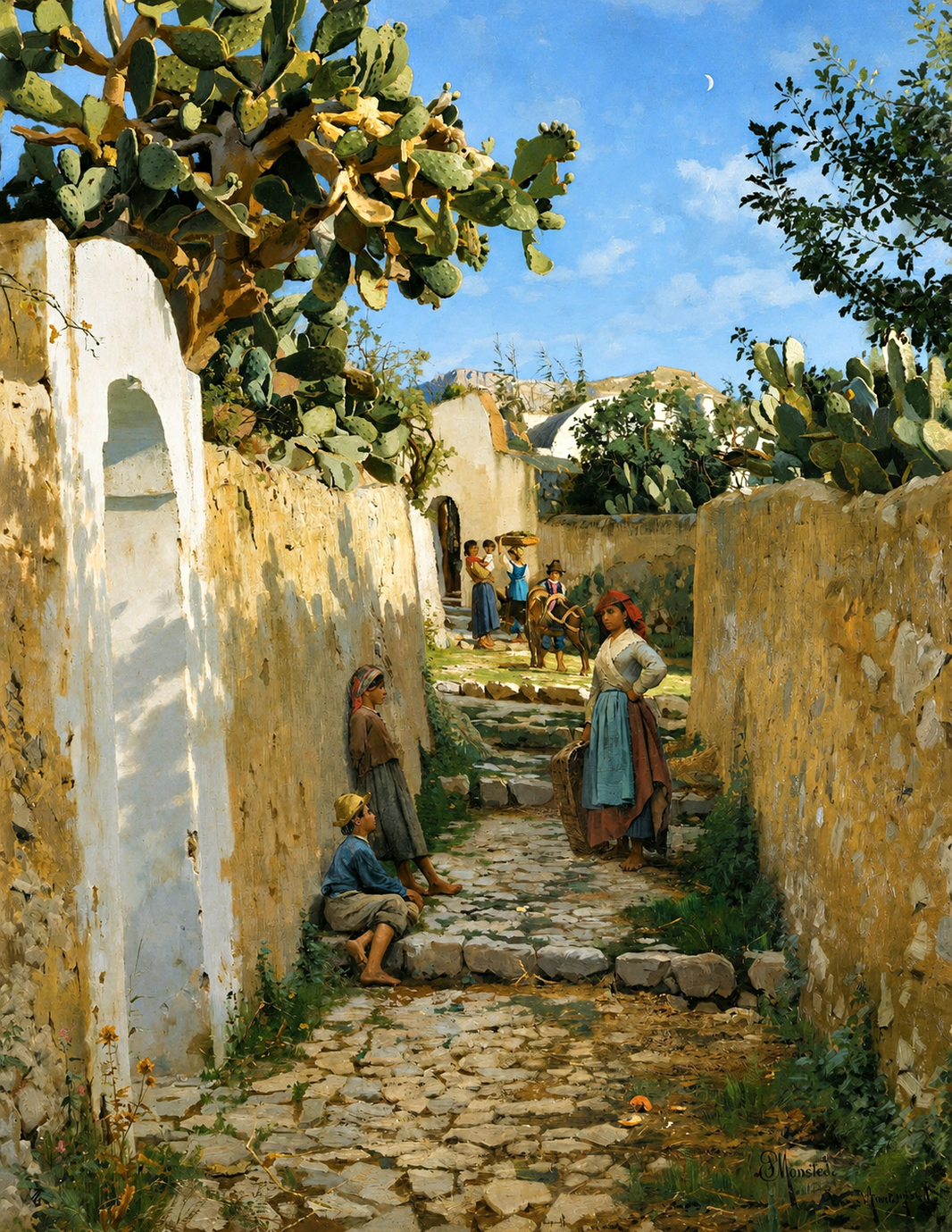
The shift to Capri changes the texture of the article as well as its colour. Here, stone walls, a stepped lane and broad cactus pads replace the woodland canopy. The bright blue sky is held between the enclosing walls and plants, making the view feel both intimate and sunlit.
Notice the wall on the left. The pale architectural surface catches the light differently from the rougher stone around it. Small figures along the lane help establish scale, while the uneven paving carries the eye further into the scene.
Rather than spreading detail evenly, the composition gives us a sequence of discoveries: foreground stones, people, plants above the walls, and the opening beyond. That progression is one reason the picture remains inviting despite its busy surface.
This print could bring warmth to a hallway, kitchen or breakfast area. Stone, cream and olive accents would pick up its colours, but there is no need to reproduce the whole palette in the room. The concentrated blue of the sky can remain a distinct note within the artwork.
View Sunlight In Anacapri As An Unframed Print
5. Cactus Plantation In Capri

Where Sunlight in Anacapri encloses us between walls, Cactus Plantation in Capri opens onto rougher terrain. Rounded cactus pads interrupt the rocky slopes, and a route through the foreground offers a way into the view. Small figures give the landscape a human scale without becoming its sole focus.
The contrast of surfaces is the main attraction. Broad plant shapes sit beside fractured rock; shaded crevices make the sunlit ground seem warmer; the sky gives relief from the activity below. Mønsted’s attention to detail helps separate these materials rather than turning them into one continuous texture.
Compare the cactus shapes with the leaves in A Woodland Stream. Both pictures depend on close observation, yet the rhythm is quite different: large rounded forms here, a finer network of branches and foliage there. It is a useful reminder of how much a landscape’s character comes from the things that grow in it.
For a garden room or living space, this is an alternative to a conventional flower painting. Its greens are grounded by stone and earth colours, giving it warmth as well as botanical interest.
View Cactus Plantation In Capri As An Unframed Print
Choosing A Landscape Print For Your Space
Begin With The Kind Of Light You Enjoy
Think about the atmosphere you want to live with. The two woodland pictures offer shade, reflections and layered greens. Sunny Winter Day feels more open and restrained. The Capri paintings bring warmer stone colours and stronger contrasts between sun and shade. Choosing between them is less about finding the best-known work than recognising the view you want to revisit.
Give Detailed Paintings Room
A small reproduction can be intimate, but intricate branches and reflections need enough space to remain legible at your usual viewing distance. Check the sizes available on the product page and mark the proposed outer frame dimensions on your wall. Include the extra width of any mount and frame, rather than measuring only the print.
Let The Frame Support The Landscape
An unframed print gives you control over its final presentation. A restrained natural-wood frame can work with earthy colours, while a darker frame may pick up the deeper tones of a woodland scene. A mount can provide separation from a patterned wall. Ask your framer about suitable materials for long-term display, and compare samples beside the actual print before deciding.
Questions About Peder Mørk Mønsted
What Is Mønsted Best Known For?
He is best known for naturalistic landscapes, including woodland, water and winter subjects. The works in this selection also show his interest in Mediterranean scenery. His paintings reward attention both to individual textures and to the way a whole landscape is organised.
Is Peder Mork Monsted The Same Artist?
Yes. Peder Mork Monsted is a common spelling without the Danish letters ø. You may also encounter Mønsted or Mönsted in titles and catalogues. This article uses Peder Mørk Mønsted.
Do These Prints Come With Frames?
The product links in this article lead to unframed fine art prints. Frames are not included with those products, so you can choose your own presentation. Consult each listing for available sizes and specific print details.
Are These Original Paintings?
No. The linked products are reproduction prints of Mønsted’s paintings. They offer a way to enjoy the images at home; they are not original painted works by the artist.
A Landscape To Return To
A good landscape painting can become familiar without becoming exhausted. One day you notice a reflection; another day, the shape of a shadow or a small opening between trees. Mønsted’s pictures make room for that gradual acquaintance.
Explore your favourites through the artwork links above, or browse our unframed fine art print collection. For more ideas across different artists, read Eight Peaceful Paintings For Your Home.
Sources And Further Reading
Biographical background: Dahesh Museum of Art, Peder Mork Mønsted’s Poetic Views Of Nature. For a museum example of his winter painting, see the Dahesh collection’s Snow Scene, a different work from Sunny Winter Day featured above.
Visual commentary and room suggestions are Peaceful Artworks’ own interpretations.